Drone spins or toilet-bowls on takeoff
We pull the flight logs, run a magnetic survey, and recalibrate the compass on the bench. If the IMU is also off, we calibrate both on the same stand and test-fly through a figure-eight before you pick it up.
Drone compass calibration Houston TX is the fix when your aircraft drifts, spins, or throws a compass error the moment you arm the motors. We run full magnetometer sweeps on DJI, Autel Robotics, Parrot, and Skydio platforms, clear the interference, and test-fly every ship before it goes home. If you fly commercially under FAA Part 107, a bad compass is a grounded aircraft and a missed job. Bring it to our Harris County bench and we will have you back in the air the same day.
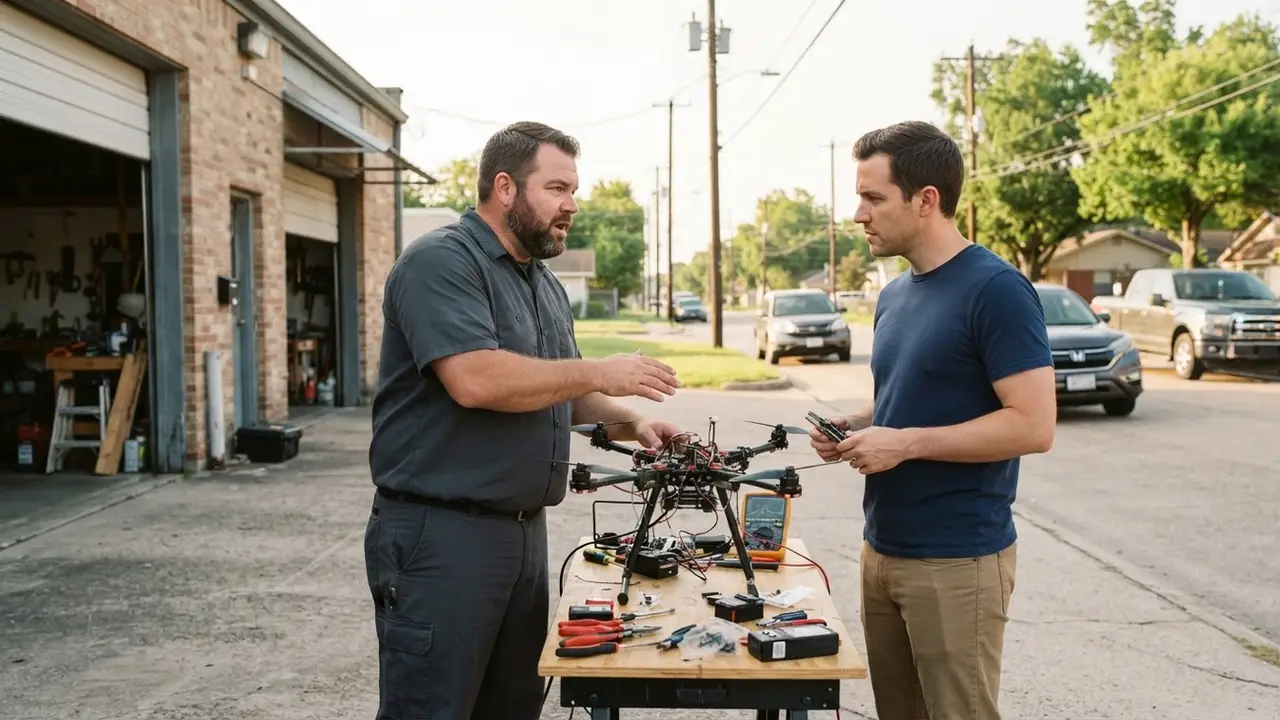
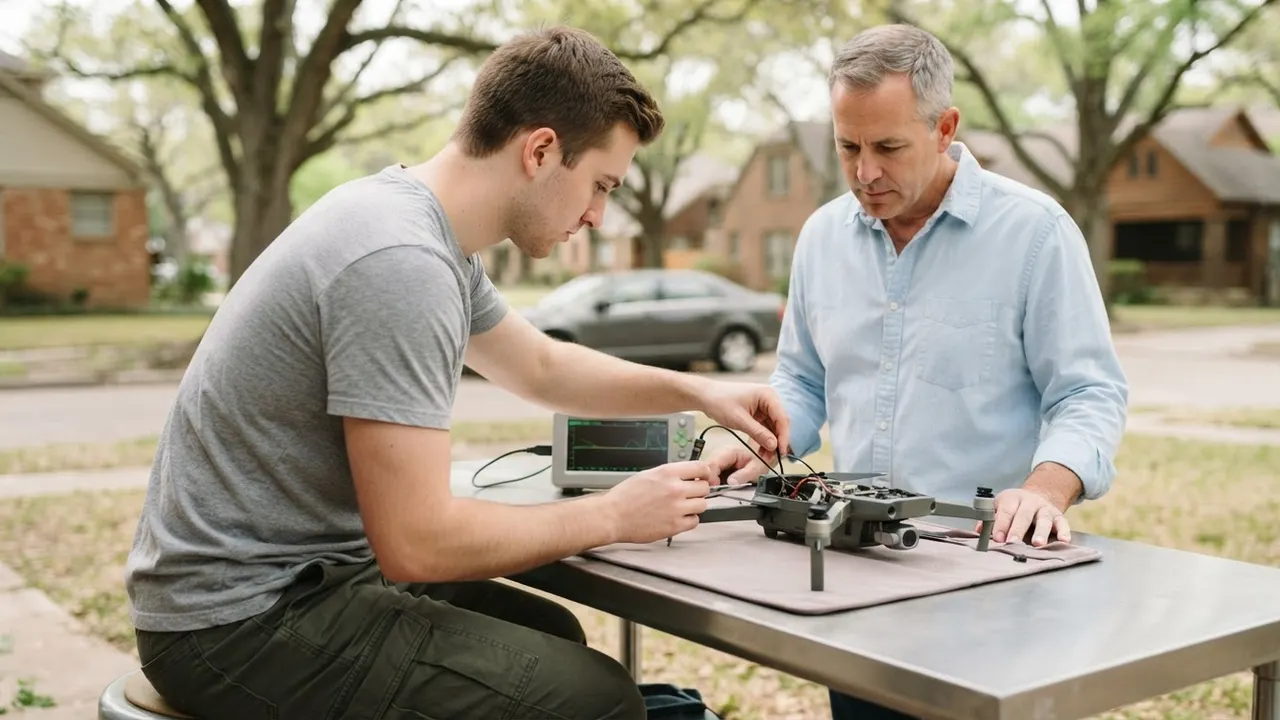
Drone compass calibration Houston TX is a magnetometer service that removes the magnetic bias your aircraft picks up from cars, rebar, power lines, and steel benches, then re-establishes a clean heading reference the flight controller can trust. We pull the logs with a multimeter and oscilloscope, check the compass module and GPS antenna, and run a full 360-degree rotation on an IMU calibration stand away from magnetic interference. Most jobs take 45 to 90 minutes on the bench, and every aircraft gets a hover test before it leaves.
Houston flying conditions punish compasses. Launch from a downtown parking garage off 77002 and the rebar under the pad throws your heading off by 30 degrees or more. Fly the Energy Corridor near high-tension lines and you get intermittent compass calibration errors mid-flight. We see this weekly from pilots in Bellaire, Clear Lake, and the Woodlands Area. If you search for drone compass calibration near me Houston, this is the shop that keeps a gauss meter on the bench and a test pad out back.
Every compass job includes the bench work, the test flight, and the documentation. If we find a hardware fault during the calibration, we quote the repair before we touch anything. Here is what you get.
We map the magnetic field at the compass module with a gauss meter and check the wiring with a multimeter. This tells us whether the interference is environmental or coming from a failing component.
On an IMU calibration stand away from steel and power, we run the full rotation and let the flight controller write a fresh compass offset. We repeat the sweep twice to confirm the values hold.
Every aircraft gets a 3 to 5 minute hover test through a figure-eight pattern. We watch the heading readout the whole time and redo the calibration if it drifts more than 3 degrees.
You get a one-page report with the gauss readings from before and after, the hover test result, and any parts we replaced. Commercial operators use this for Part 107 records and client files.
We show you the spots around your usual launch areas where the compass will still act up, like parking garages, steel benches, and power lines. That knowledge saves you a flyaway.
You drop the aircraft at our Harris County bench and we pull the flight logs within the hour. We check the last compass calibration error, the heading deviation, and the GPS lock time. If the logs show a hardware fault rather than a calibration issue, we tell you before any work starts.
We walk the aircraft around a gauss meter and a multimeter to map the magnetic field at the compass module. This takes 10 to 15 minutes and tells us whether the interference is coming from the module itself, the GPS antenna, or wiring near the flight controller.
On an IMU calibration stand away from steel and power, we run the full 360-degree rotation and let the flight controller write a fresh compass offset. We repeat the sweep twice to confirm the values hold. This is the core of any drone compass service Houston TX job.
Out on our test pad we hover the aircraft for 3 to 5 minutes through a figure-eight pattern and watch the heading readout. If the compass drifts more than 3 degrees, we go back to the bench. Nothing leaves the shop without passing this test.
You get a one-page report with the before and after gauss readings, the hover test result, and any parts we replaced. We walk you through it at pickup and show you the two spots in your neighborhood where the compass will still act up.
Purpose-built equipment, used by trained technicians — so the job is done accurately the first time.
Measures the magnetic field at the compass module so we can pinpoint interference from the airframe, wiring, or the environment before we calibrate.
Holds the aircraft level and away from steel during the 360-degree rotation, so the flight controller writes a clean compass offset.
Checks the signal quality from the compass module and GPS antenna. A noisy signal looks like a calibration problem but is actually a failing component.
Tests voltage and continuity through the compass wiring and the flight controller. Catches shorts and bad grounds that throw off the heading reference.
Balances every set of propellers before the test flight. Vibration from unbalanced blades can throw off the compass and IMU during flight.
Finds hot spots on the ESCs and flight controller that can indicate a failing component and cause compass drift under load.
A commercial operator in the Energy Corridor was getting 20 to 30 degree heading drift on every survey flight. The aircraft threw compass errors near the power lines and the footage was unusable. He had tried calibrating on site three times with no luck.
We ran a magnetic survey, found the compass module was picking up interference from a wiring run near the flight controller, rerouted it, and recalibrated on the bench. The hover test showed a 2-degree deviation. His next three survey flights came back clean.
A hobbyist in Clear Lake clipped a fence and the aircraft started throwing a compass calibration error on every arm. The frame was cracked near the compass module and the heading was off by more than 40 degrees. He was ready to buy a new drone.
We repaired the carbon fiber frame, replaced the compass module, and recalibrated on the IMU stand. The test flight held a 2-degree heading through a figure-eight. Total cost was a fraction of a new aircraft.
A Part 107 operator left his Phantom 4 in a truck bed through a Houston summer. The compass drifted 15 degrees and two LiPo packs had swollen. He was getting intermittent compass errors and shorter flight times.
We replaced the swollen packs, calibrated the compass on the bench, and test-flew the aircraft. Heading deviation dropped to 2 degrees and flight time went back to 22 minutes per pack. The report documented everything for his Part 107 file.
These are the calls we get most often from Houston pilots. If any of these sound familiar, do not fly the aircraft until we have looked at it.
Ask a pro →We pull the flight logs, run a magnetic survey, and recalibrate the compass on the bench. If the IMU is also off, we calibrate both on the same stand and test-fly through a figure-eight before you pick it up.
We check the compass module, GPS antenna, and wiring for faults. If a component is failing, we replace it and recalibrate. If it is environmental, we show you the launch spots around Houston to avoid.
We run a full drone compass adjustment Houston service, verify the GPS antenna, and test-fly the aircraft. Most drift complaints are gone after one bench session and a fresh calibration.
We repair the frame or module, then recalibrate on the bench and test-fly. The report shows the before and after heading deviation so you know the aircraft is safe.
$85 - $165 for most compass calibrations, plus parts if needed
Typical 2026 pricing for a compass calibration in Houston runs $85 to $165, depending on the airframe and whether we replace a part. A straight calibration with no hardware issues is on the low end. If we find a failed compass module or GPS antenna on a DJI Mavic 3 or Autel EVO II, expect the higher number. We quote before we start, and the test flight is always included. Commercial operators with multiple aircraft get a volume rate. Call +1 281 555 4468 for a quote on your specific model.
A $85 calibration is cheaper than a $1,200 replacement drone. We test-fly every aircraft, document the numbers, and show you where your compass will still struggle around Houston. That is the difference between a calibration and a real fix.
Smaller airframes like the DJI Mini series calibrate faster and cost less. Larger commercial platforms like the Matrice or Autel EVO II take longer on the bench and may need a payload-specific calibration.
If the compass module, GPS antenna, or wiring is faulty, we replace it. A compass module for a common DJI airframe runs $25 to $60 in parts, plus bench time. We quote the full job before we start.
An aircraft that has been crashed or submerged needs more than a calibration. We repair the damage first, then calibrate. That adds time and parts to the job, and we tell you the number upfront.
Thermal cameras, LiDAR units, and heavy payloads shift the magnetic field. We calibrate with the payload installed, which takes longer but gives you a calibration that matches real flight conditions.
“I run survey flights along the high-tension lines out west and my Mavic 3 kept throwing compass errors mid-mission. Houston Drone Repairs Pros calibrated it, showed me the before and after gauss readings, and test-flew it. Three weeks later, zero errors. They also told me which two launch spots to avoid. Worth every dollar.”
Marcus T.Commercial Operator, Energy Corridor
✓ Verified“My drone was drifting so badly I could not hold a straight line for exterior shots. I dropped it off at 10 a.m. and had it back by 4 p.m. the same day. The heading is rock solid now. They even balanced the propellers while it was on the bench and my flight time went up by two minutes per battery.”
Priya S.Real Estate Photographer, The Heights
✓ Verified“I crashed my Autel EVO into a fence and the compass was toast. They repaired the frame, replaced the compass module, and recalibrated everything. The test flight report showed a 2-degree heading deviation. I have flown it a dozen times since and it tracks straight as an arrow. Fair price, no upsell.”
Danny R.Hobbyist, Clear Lake
✓ VerifiedMost compass calibrations run $85 to $165 in 2026, depending on the airframe and whether we replace the compass module or GPS antenna. A straight calibration with no parts is on the low end. If we find a failed module on a DJI Mavic 3 or Autel EVO II, expect the higher number. We quote before we start, and the test flight is included.
Our bench is in Harris County and we serve pilots from Downtown Houston out to Katy, Clear Lake, and The Woodlands Area. Drop-off is the fastest option, and same-day slots are usually open if you call before noon. We also do pickup and delivery for commercial operators running multiple aircraft.
Houston is full of magnetic interference. Parking garages, rebar in concrete pads, high-tension lines along the Energy Corridor, and steel truck beds all throw off the magnetometer. Add summer heat that pushes LiPo batteries past 110 degrees and the compass module drifts more. If you launch from the same spot every time, the bias builds up until the aircraft refuses to arm.
Yes. Every aircraft we calibrate gets a 3 to 5 minute hover test through a figure-eight pattern on our test pad. We watch the heading readout the whole time. If it drifts more than 3 degrees, we go back to the bench and redo the calibration before you pick it up.
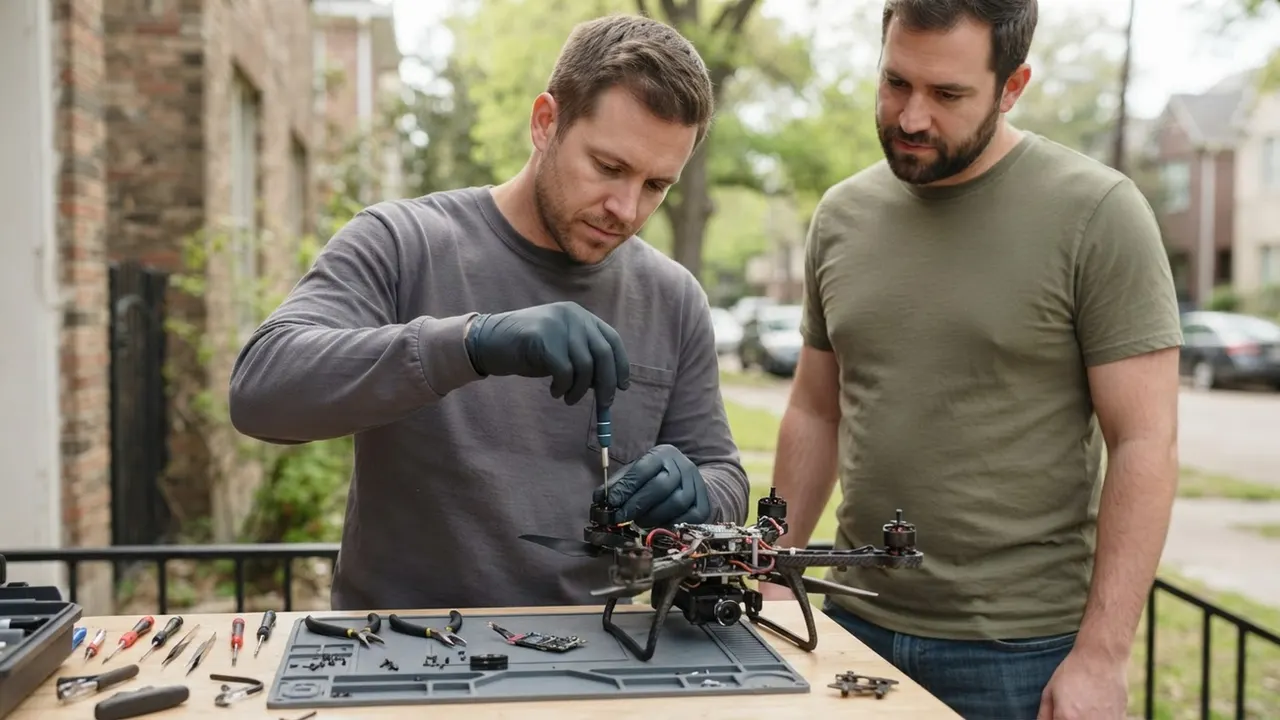 Drone RepairWhen a hard landing in Bellaire bends more than the compass, our full drone repair service covers the airframe, motors, and electronics. We diagnose the whole aircraft on the same bench visit so you are not paying two drop-off fees.Explore →
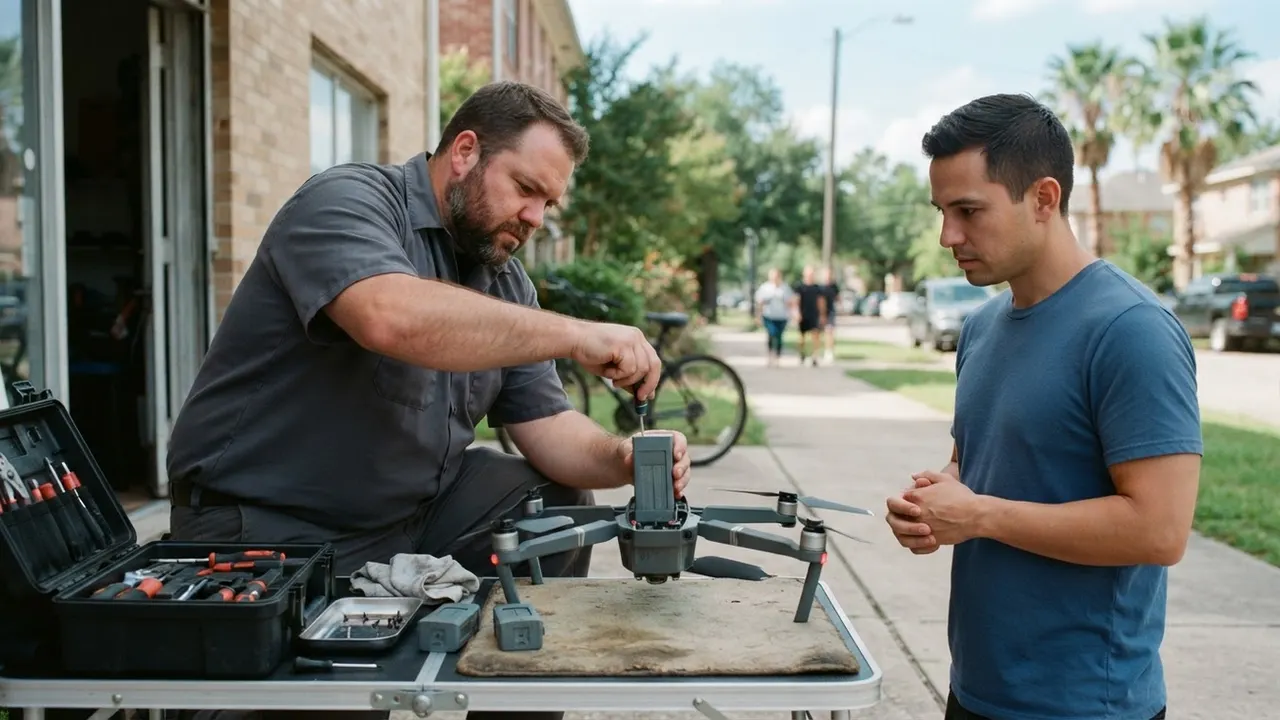 Drone Battery ReplacementA swollen LiPo battery changes the voltage reference the flight controller uses, which can mimic a compass fault. We test every pack under load and replace cells that are past their cycle life before they damage the airframe.Explore →
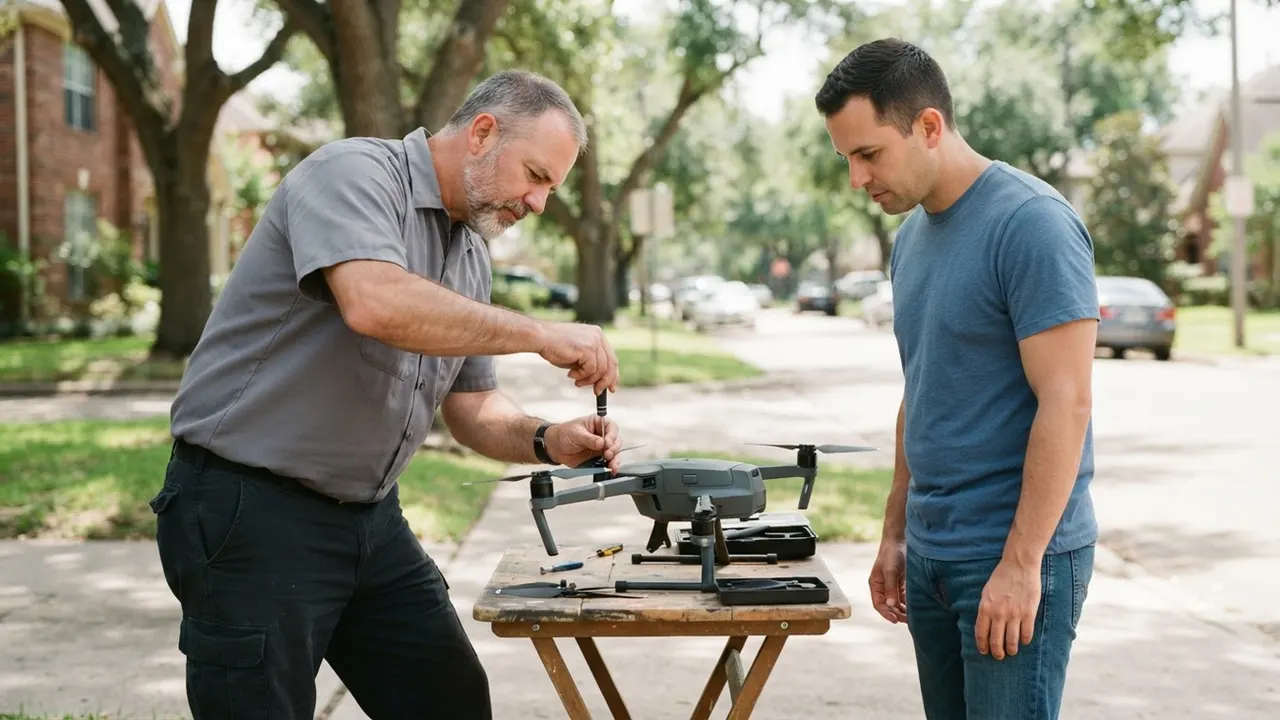 Drone Propeller ReplacementBent or unbalanced propellers cause vibration that throws off the compass and IMU. We balance every set on a propeller balancer and swap damaged blades so your calibration holds through the whole flight, not just the first minute.Explore →
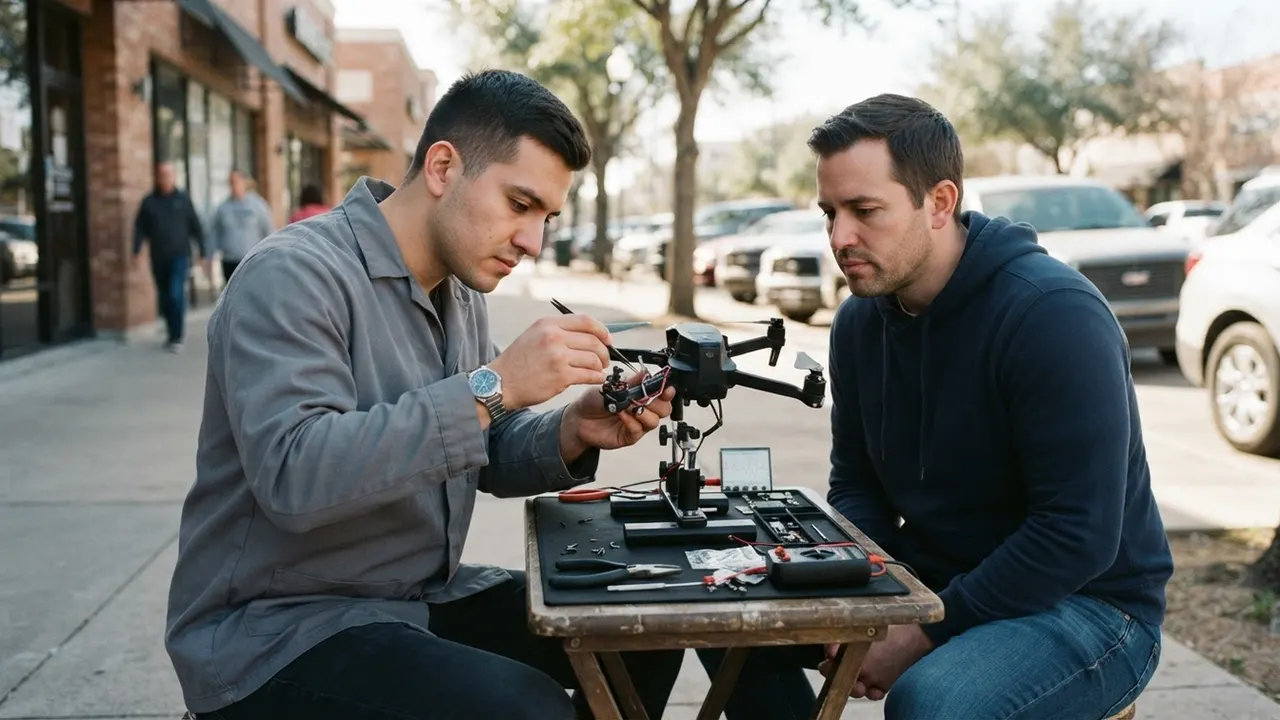 Drone Motor RepairA failing brushless motor pulls uneven current and can drag the compass heading off course. We test each motor with an oscilloscope and replace bearings or whole motors when the readings fall out of spec.Explore →
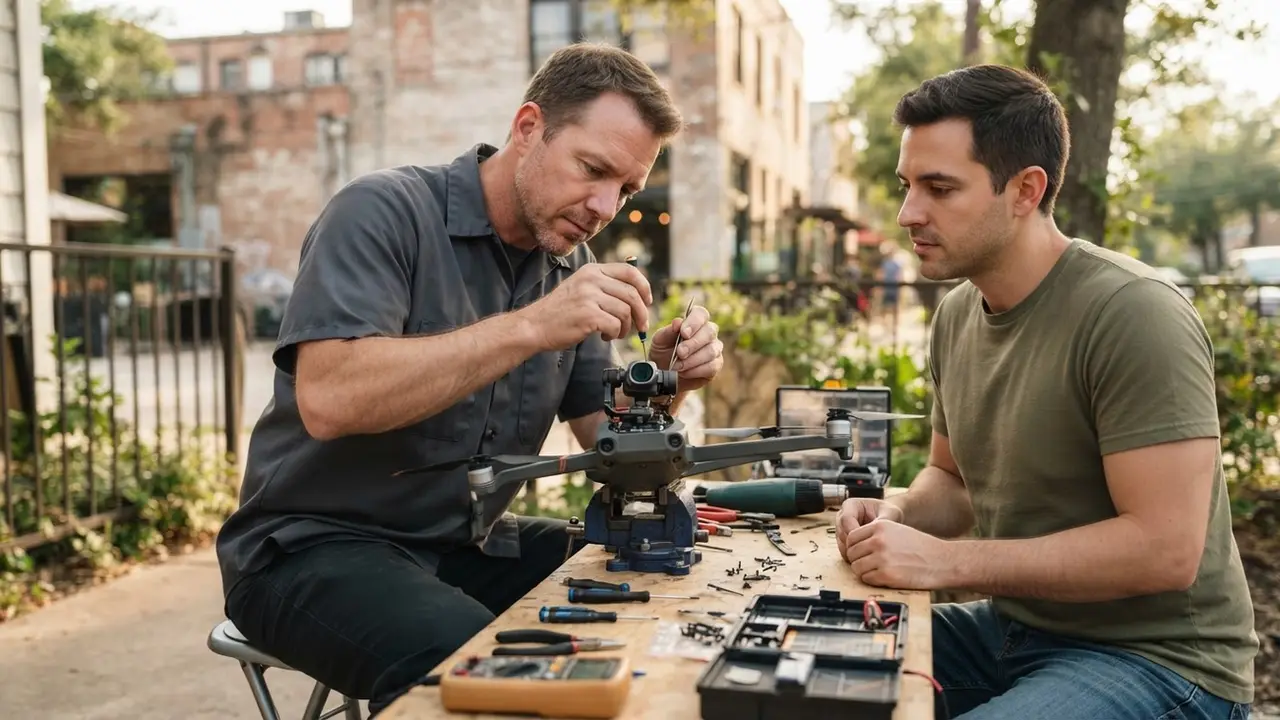 Drone Gimbal RepairGimbal malfunction and compass drift often show up together after a crash. We repair the gimbal, recalibrate the compass, and test both on the same flight so your camera stays level and your heading stays true.Explore →
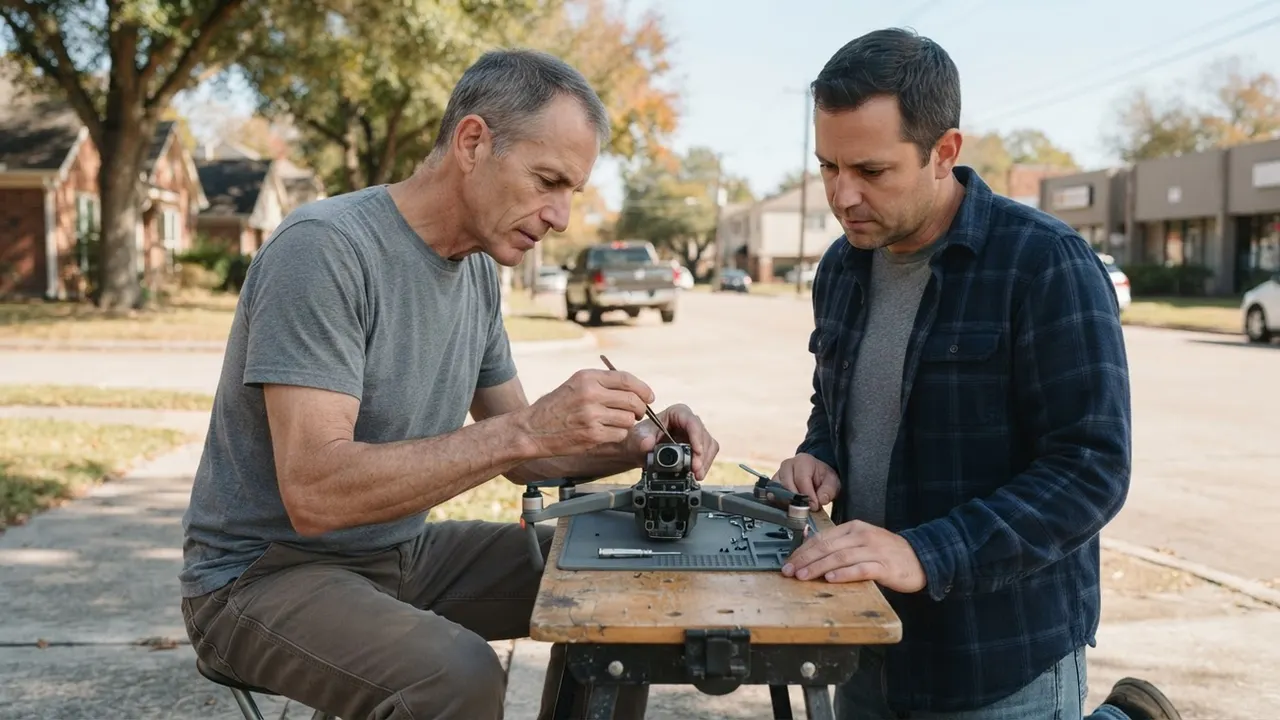 Drone Camera RepairA camera black screen after a hard landing usually means a ribbon cable or module issue. We fix the camera and check the compass while the aircraft is open, since both share wiring runs near the flight controller.Explore →
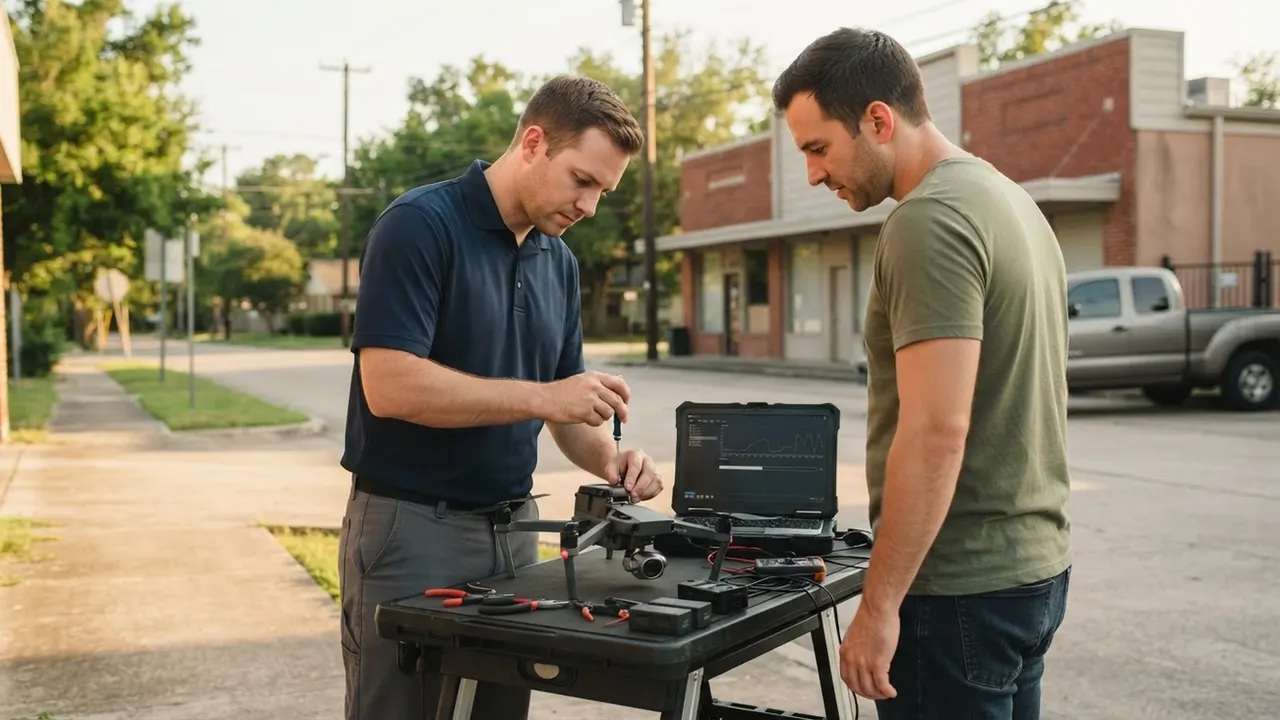 Drone Firmware UpdatesFirmware issues can wipe your compass calibration or introduce a bug that causes drift. We update to the latest stable firmware, then recalibrate the compass so the new software starts from a clean baseline.Explore →
 Drone Software RepairCorrupted flight controller software can throw compass calibration errors that look like hardware faults. We reflash the controller, restore factory parameters, and recalibrate the compass as part of the same service.Explore →
If your aircraft is drifting, spinning, or throwing compass errors, do not fly it. Bring it to our Harris County bench and we will diagnose it, calibrate it, and test-fly it before you leave. Same-day slots are usually open. Call +1 281 555 4468 and we will get you on the schedule.
Book Calibration +1 281 555 4468 →Call us at +1 281 555 4468 or stop by the shop. We are open Monday through Friday, 8 a.m. to 6 p.m., and we answer emergency calls 24/7 for commercial operators. Most diagnostics are done the same day you drop off.